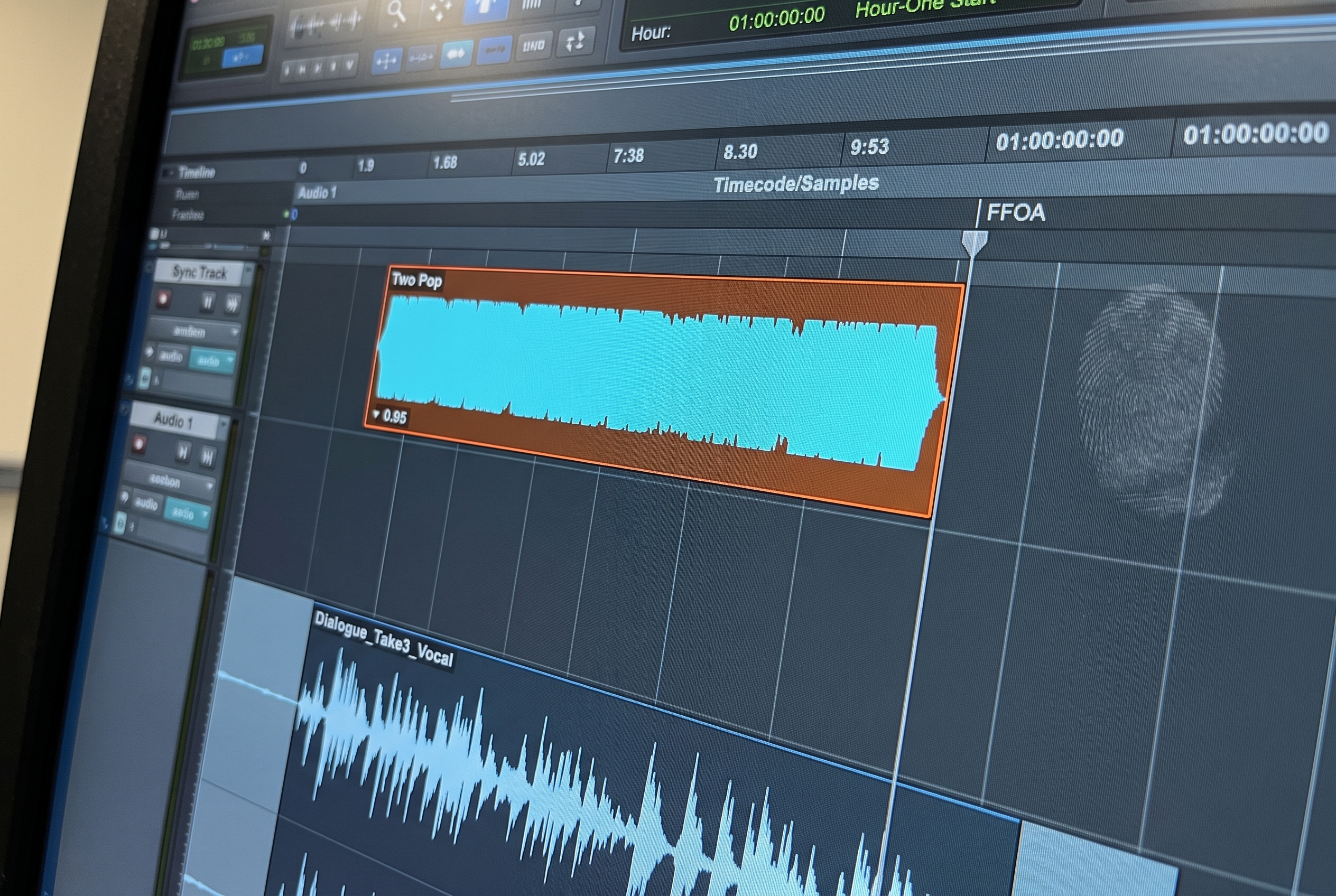
Picture lock is meant to be the moment audio post can build a session and trust the timing of every cut to stay still until the final mix. In commercial and episodic post it almost never holds. The director sees the cut in a screening room and asks for two scenes to be tightened. The agency note arrives overnight and the spot needs three new versions at different lengths. Legal flags a frame that has to come out, and every piece of audio that follows it has to slide. Each of those changes triggers a conform: a new AAF arrives from picture editorial, and the audio session that was already prepped, organized, edited, and partially mixed has to be reconciled against the new picture. This guide covers what conforming actually requires in Pro Tools, why it fails, how to catch issues before they compound, and what to do when the next cut arrives mid-project.
What Conforming Actually Means in Audio Post
Conforming is the process of bringing the audio session back into alignment with picture after a change in the cut. The picture has moved. The audio has not. The job is to identify every change between the old cut and the new one, slide existing audio to match the new positions where possible, drop in any new material that arrived with the conform, and rebuild any part of the mix the change disturbs.
The work has two layers. The first is mechanical: clips and automation that have to move in time so dialogue, music, and SFX still hit picture at the right frames. The second is editorial: every change creates new edit boundaries that have to be smoothed, new dialogue that has to be cleaned, new SFX that have to be designed or pulled, and changed mix decisions the re-recording mixer has to make. The mechanical layer can be partially automated. The editorial layer cannot.
A clean conform delivers a session where every existing piece of audio is in the right place against the new picture and every new or changed area is clearly flagged for the dialogue editor and re-recording mixer to address. A bad conform produces a session that plays in sync at the boundaries and is silently misaligned in the middle, which the mix team discovers on a stage with the client in the room.
Why Conforming Fails: The Prep Tax That Compounds
The temptation on every conform is to treat it as a small edit: nudge a few clips, fade a few transitions, move on. Conforms are not small edits. Each one re-introduces every problem the original AAF prep was meant to solve.
New material arrives raw. Dialogue clips from a re-shoot or pickup arrive on whatever tracks the picture editor placed them on. Stereo handling, naming, and routing reflect the editor's workflow, not the audio post template. Premiere-sourced conforms can include the dual-mono problem on any new clip, even if the original AAF was clean. Track count can change. Clip names can collide with existing names in the session.
Existing material has to move. Automation lanes, sends, plugins, and routing the dialogue editor and re-recording mixer have already built do not always survive a slide. Manually moving fifty clips four frames left risks breaking the relative timing the mixer set in the original pass. Automated conforming tools handle the mechanical slide, but every tool has edge cases that the operator has to verify.
Session integrity has to hold across rounds. A typical commercial finishing schedule hits two to four conforms before the final mix locks. A typical narrative project can hit five or more. By round three, the session contains overlapping decisions from earlier rounds, abandoned clips no one removed, and routing that no longer matches the original template. Without discipline at every conform, session quality degrades faster than the cut is improving.
The work that the original AAF prep absorbed (track sorting, stereo cleanup, template alignment, safety copy) has to happen again on the changed material every round. The two to three hours per session that the first AAF prep takes compounds with every conform that follows.
How to Catch Conform Issues Early
The conform process is faster and more reliable when picture editorial and audio post agree on a handoff convention before the first conform arrives. Five things to lock in writing during project setup, then enforce on every delivery.
Reference cut delivery format. Every conform AAF arrives with a matching QuickTime reference at the same timecode and an EDL of the new cut. The QuickTime is what audio post works against. The EDL is the recovery document when AAF metadata is incomplete or when a comparison against the previous cut is needed.
Change list. Picture editorial maintains a short change list describing what moved between the previous cut and the current one. The list does not have to be frame-accurate. A prose description of which scenes or beats moved and why is enough to direct the dialogue editor to the right regions and prevent the audio team from re-checking parts of the session that did not change.
Versioning convention. Every cut version (AAF, QuickTime, EDL) carries the same version label: v1, v2, v2a is workable. "Final," "Final final," and "Final v3 use this one" is not. The convention is set on the first delivery and held through every conform.
Handle length. Handles are set the same way for conforms as for the original. Ten seconds (240 frames at 24fps, 250 at 25fps, 300 at 29.97fps) is the professional standard for dialogue editing. Conform AAFs delivered with zero handles produce changed regions that have no audio to work with beyond the exact frame of the cut, and dialogue editing on those regions blocks until a re-export arrives.
Inactive and locked tracks. Picture editorial confirms before every conform export that no tracks are marked inactive or locked. Inactive and locked tracks do not export from Avid Media Composer and are silently absent from the AAF. Audio post discovers the gap when a scene's production sound is missing from the conformed session.
When a New Cut Arrives Mid-Project: The Two Paths
There are two structurally different approaches to conforming a Pro Tools session. Most facilities use both, depending on the size of the change.
Path 1: Dedicated conforming tools. Tools like Matchbox (from The Cargo Cult), EdiLoad (from Sounds in Sync), and Virtual Katy take a reference of the old cut and the new cut and compute a delta. The tool applies that delta to the Pro Tools session: clips slide, automation slides, unchanged regions are left in place. The output is a session re-aligned to the new picture with the existing audio decisions preserved.
Pro Tools 2025.6 introduced Matchbox 2 integration with a Smart Conform workflow that operates clip by clip rather than on the timeline as a whole. Clip-by-clip conform reduces the cases where a single edit boundary shifts an entire region the wrong way, and lets the tool move clips and the automation attached to them as a unit. (Source: Production Expert.)
Dedicated conforming tools handle the mechanical layer well. They do not handle new material that did not exist in the original cut, and they do not handle track-level reorganization that picture editorial has done since the last delivery (renamed tracks, new tracks added, tracks removed). For pure timing changes, the tool path is the fastest.
Path 2: New AAF re-import. Picture editorial delivers a new AAF representing the new cut, and audio post imports it as the source of truth and reconciles the existing session against it. This is the right path when the changes include new material, new tracks, renamed tracks, or any structural change to the picture editor's audio organization.
The advantage is completeness: every piece of audio in the new cut is present, organized, and timecoded by the source. The cost is that every prep step the original AAF required (template matching, track sorting, stereo cleanup, routing, safety copy) has to run again on the new AAF before the session is workable.
Most facilities use a combination: the dedicated conform tool for sliding existing material and the new-AAF re-import for any material that did not exist in the original cut. The dialogue editor reconciles the two views into a single session. For episodic and commercial workflows where multiple AAFs land on each conform round, the new-AAF re-import path is where the prep tax compounds across episodes and across rounds.
How fPost Handles Conform AAFs
The new-AAF re-import path is the slower of the two conform paths because it re-introduces every prep step the original AAF prep required. fPost was built to absorb that step.
fPost imports an AAF, classifies the audio with AI-R as dialogue, SFX, or music, and maps the result to the facility's Pro Tools template with routing, folder structure, color coding, and clip placement. It runs the same way on a conform AAF as on an original AAF. New material from the conform arrives organized to the same template the previous cut used. Dual-mono cases on any new Premiere-sourced clips are detected and converted. The safety copy of the unmodified conformed AAF is preserved alongside the organized version. The dialogue editor's work starts from a session that looks like the previous round's session, with the changed regions clearly identifiable rather than mixed into a generic track dump from picture editorial.
For facilities running two to five conforms per project before lock, the prep tax that conforms re-introduce is one of the largest invisible costs in the schedule. Automating the AAF prep step on every conform turns hours of administrative work back into minutes per round, every round.
Frequently Asked Questions
What is the difference between conforming and re-conforming?
Conforming is the broader term for bringing audio into alignment with a picture cut. Re-conforming describes the work when it happens after audio post has already prepped a session against an earlier cut: a second, third, or fourth conform on the same project. In practice the work is the same, applied iteratively across cut versions until picture is genuinely locked.
Do I need a dedicated conforming tool, or can Pro Tools do it natively?
Pro Tools 2025.6 introduced Matchbox 2 integration with a Smart Conform workflow. For dedicated conform work at facility scale, third-party tools (Matchbox, Conformalizer, EdiLoad, Virtual Katy) have historically been the standard. The choice depends on the size and frequency of conforms and on the facility's existing workflow.
What happens to my mix automation during a conform?
Dedicated conforming tools move the automation along with the clip when the clip slides as a unit. Smart Conform clip-by-clip conforming preserves automation attached to each clip. Manual conforms require the operator to verify automation lanes after each move. New material that did not exist in the previous cut has no automation and is added to the session as raw audio for the mixer to address.
How long should a typical conform take?
The mechanical slide can take minutes for a small change and an hour or more for a heavy re-cut. The dialogue editing work that follows the slide takes longer: 30 to 60 minutes for a tight commercial conform, half a day for a scene re-cut on narrative work. The variance is in the editorial layer (boundary smoothing, ADR placement, perspective matching) more than in the timing alignment.
Can fPost handle a conform AAF the same way it handles the original AAF?
Yes. fPost imports any AAF, including conform AAFs, classifies content as dialogue, SFX, or music, and applies the facility template. New material in the conform arrives organized to the same template the previous cut used, and the safety copy of the original conform AAF is preserved alongside the organized version.
fPost automates AAF import and session organization for Pro Tools, including on conform AAFs delivered after picture lock. AI content classification, template routing, stereo and mono correction, and Import Session Data preservation run on every AAF the same way. Demo at forte-ai.com/demo.