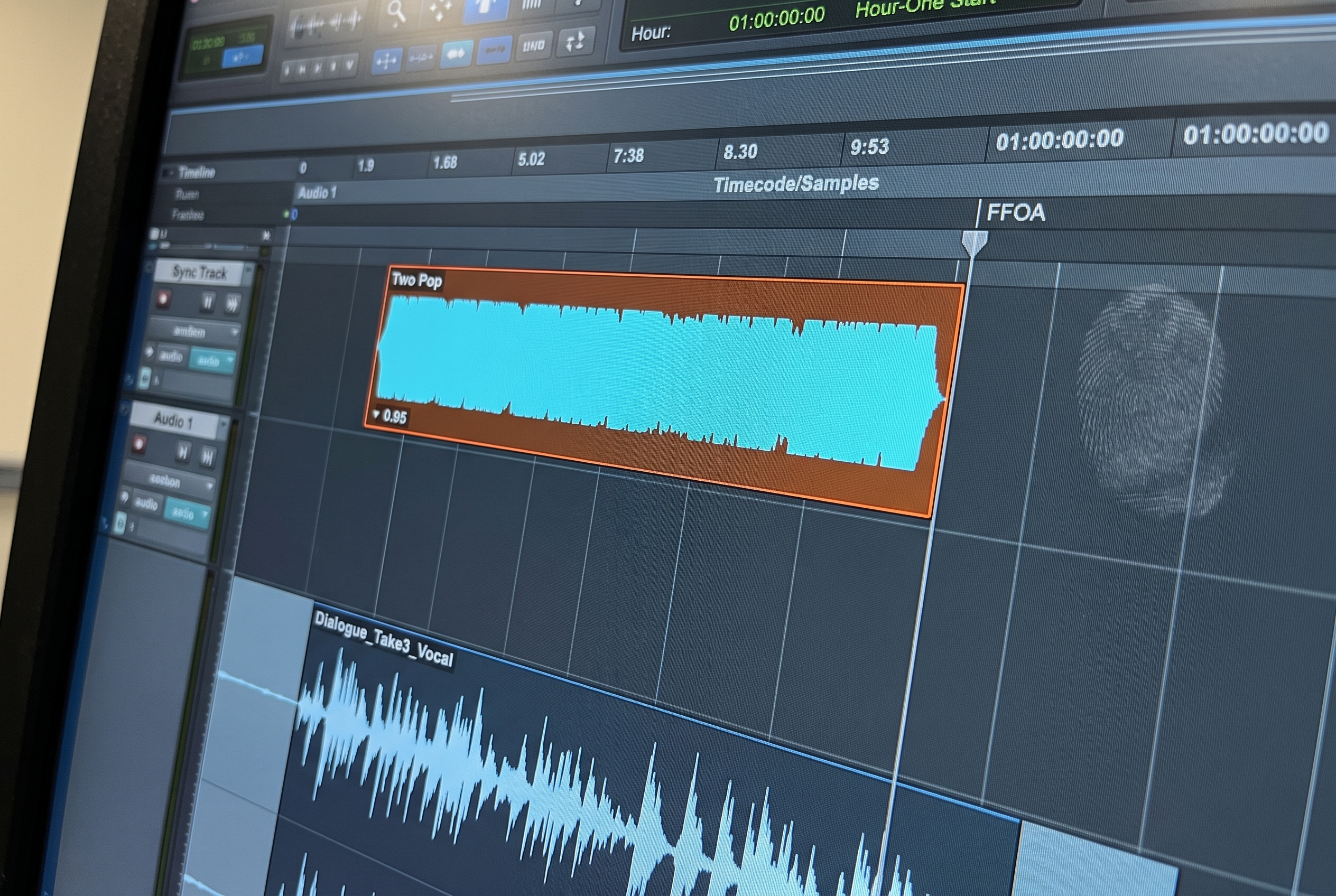
Automated Dialogue Replacement is what happens when production dialogue cannot deliver. The reasons are practical: a plane flew over the close-up, the lavalier failed mid-take, the actor's performance changed in the cutting room, the legal team flagged a line, the international cut needs a clean version. ADR is the second chance, and the workflow that produces it has more moving parts than any other dialogue task in audio post. This guide covers the full sequence: spotting the cut, building the cue list, handing off to the ADR stage, recording with the actor, editing the result back into the dialogue session, and routing it through to a deliverable that holds across every conform between picture lock and final mix.
When ADR Is Needed
ADR enters the schedule for one of four reasons. Intelligibility: the production take is unusable due to wind, traffic, equipment failure, or room acoustics that restoration cannot rescue. Performance: the director or editor wants a different read on a specific line, with the actor brought back to record alternates against picture. Story or legal change: a line is replaced because the script changed, the legal review flagged it, or the cut moved a beat that requires different dialogue. Cleaning for international or M&E deliveries: a clean ADR pass is recorded for use in international dubs, censored versions, or music-and-effects deliveries that have to be free of certain language.
ADR is expensive and disruptive. The actor's schedule has to align with the ADR stage's availability, the picture editor has to sign off on the line list, and the dialogue editor has to fit the recorded result into the existing session. Workflows that catch ADR needs early in the spotting phase save days against workflows that surface them during the mix.
Spotting and the Cue List
Spotting is the first formal pass through the cut for ADR identification. The dialogue supervisor (or in smaller workflows, the dialogue editor) watches the cut against production sound and flags every line that needs replacement. The output is a cue list: a structured document that becomes the contract between audio post, the ADR stage, and the actor's representatives.
A cue list entry contains, at minimum: cue number, character name, timecode in and out, scene number (when available from the production sound database), line text as written or as performed, reason for ADR (intelligibility, performance, story, M&E), and any tone, perspective, or technical notes.
The cue list is built in Pro Tools by placing markers at every flagged moment, then exporting the marker list as CSV or transferring it to a dedicated ADR cue list template. Some facilities use third-party ADR management tools that read directly from a Pro Tools session.
The line-by-line discipline of cue-list building is what makes the ADR session productive. An actor stepping into a booth records dozens of lines in an hour when the cue list is clean and the playback is aligned. The same hour produces five usable lines when the cue list is ambiguous and the supervisor pauses every cue to clarify what is being recorded.
The Handover from Edit to ADR Stage
The ADR stage receives three things from the picture-editorial side: the cue list, a reference cut for playback, and any production audio that the actor will hear during recording (the original take, room tone, scene partners). The handover document specifies which cues are recorded against which scene partners, whether the actor is performing solo or to a playback of another performer, and whether wild lines (recorded without picture sync) are part of the schedule.
For multi-character ADR sessions, scheduling matters as much as the cue list. An ADR session with two actors recording simultaneously is rare; most sessions are one actor at a time. A 20-cue session with two actors is two separate two-hour blocks, not one four-hour block.
Reference timecode for the ADR cut has to match the dialogue editor's session. If the dialogue editor is working against picture v3 and the ADR stage records against picture v4, the recorded cues land at slightly different timecode positions than expected, and every cue has to be re-synced manually. The handoff document carries the picture version and locks both sides to it.
Session Layout for ADR in Pro Tools
ADR sits separately from production dialogue in the Pro Tools session, with its own track group, routing, and stem assignment. The full layout sits inside the broader audio post production workflow; the ADR-specific structure has the following.
Dedicated ADR tracks. ADR 1, ADR 2, and so on, separated from production dialogue tracks. The track count depends on the project. A two-character drama might have two ADR tracks; a multi-character episodic show might have eight. The tracks are defined in the facility template so the dialogue editor does not build them per project.
Routing to a dedicated ADR sub-bus. ADR routes through its own sub-bus that runs parallel to the production dialogue bus. The sub-bus feeds the dialogue stem at the same level, but it can be soloed, muted, or printed independently when deliverables require it.
Distinct color coding. ADR clips carry a track color that distinguishes them from production dialogue at a glance. The mixer working through a scene knows immediately whether a given moment is production sound or replaced.
Playback tracks for the ADR session itself. When ADR is being recorded, the playback the actor hears (production track, click, room tone) is built on dedicated playback tracks in the ADR stage's session. These tracks are separate from the deliverable session and exist only for the recording phase. The Pro Tools session template covers how a facility encodes these structural decisions.
Playback Setup: What the Actor Hears
The playback mix in an ADR booth is its own craft. The actor performs to a mix that includes the production take of the line being replaced, the scene partners' production dialogue, room tone for the location, and a click or beep system that cues the start of each line.
The production take. The actor hears the original take of the line being replaced. This is the reference for performance: rhythm, breath placement, emotional read. ADR that ignores the production take produces a recording that is technically clean but does not match the energy of the moment.
Scene partner dialogue. Other characters' production dialogue plays in context so the actor reads against them. For a complex multi-character scene, only immediately adjacent dialogue plays, to avoid confusing the actor with too much reference.
Room tone. The ambience of the production location plays underneath so the actor's vocal energy matches the acoustic context the line will sit in.
Three-beep cue system. Three short beeps before the line, with the third marking the exact start. It gives the actor a count-in and a sync reference. Some facilities use a streamer (a visual line on the picture monitor) instead of or alongside the beeps.
The ADR mixer adjusts the playback mix live based on what the actor needs. A confident performer may want less reference; a performer fitting tightly against a complex sync point may want only the original take and the click.
Editing ADR Into the Dialogue Session
Once the actor has performed multiple takes of each cue, the dialogue editor selects the take that fits and edits it into the session. Three layers.
Take selection. Listening through the recorded takes, identifying the strongest performance, and confirming sync against the production take's rhythm. A line that performs well but lands a half-syllable late is unusable; a softer take with tight sync is the better choice.
Sync to picture. Even with the three-beep system, ADR rarely lands in perfect sync on the first take. The dialogue editor nudges clips frame by frame against picture, watching mouth movements and matching consonant onsets. Pro Tools' Beat Detective or Vocalign-style tools handle some sync work; the rest is manual.
Acoustic match. The ADR booth sounds different from the production location. Reverb, EQ, and ambient bed adjustments make the ADR clip sit in the same acoustic space as surrounding production dialogue. The full match happens during the mix; the dialogue editor does the first pass in the edit so the mixer hears the intended placement, not the dry booth take.
ADR clips on the ADR tracks are colored, named consistently with the cue list (cue number plus take identifier), and grouped by character or scene depending on facility convention. The session structure built during the PTX session prep holds the ADR work alongside production dialogue without confusing the two.
Conforming ADR Through Picture Revisions
A picture change after ADR has been recorded is one of the more painful conform cases. The ADR was performed against a specific cut, with sync timed to that cut, and a new cut may move the moment the ADR was meant to land in.
Sync drift. The ADR was tight against picture v3; in picture v4 the same scene moved by 12 frames. The recorded clip slides 12 frames against the new picture and lip sync goes off. Manual re-sync per affected clip is the standard fix.
Scene removed entirely. The scene the ADR was recorded for has been cut. The clips are no longer needed; the dialogue editor moves them to an inactive track or archive area in the facility template.
New ADR needed. The new cut introduces a moment that did not exist before. A cue list addendum goes back to the ADR stage; the actor returns for a pickup if available, or a wild line is recorded by a dialogue performer for fill.
The ADR layer carries through every conform with the same prep tax as production dialogue. A workflow that absorbs the structural restart on production dialogue conforms typically absorbs it on ADR conforms the same way.
How fPost Handles ADR in the Session
ADR sits inside the dialogue group at the AI-R classification layer. fPost's content analysis identifies clips as dialogue, SFX, or music; it does not classify ADR versus production dialogue, because both are dialogue at that layer. The within-dialogue separation (ADR clips on ADR tracks, production dialogue on production tracks) happens through the facility template that fPost applies and through clip naming conventions from the ADR session.
fPost handles the AAF prep step that produces the dialogue group inside the Pro Tools session: routing in place, color coding applied, ADR sub-bus assigned to its delivery stem, ADR tracks present in the layout. The dialogue editor sorts ADR clips to the ADR tracks and production clips to the production tracks, supported by the cue list and editorial decisions made during the ADR session. The structural restart between picture editorial and audio post is automated; the within-dialogue assessment that requires listening is not.
Frequently Asked Questions
What is the difference between ADR and dubbing?
ADR replaces a line of an actor's own dialogue, recorded by the same actor in a studio against the original picture cut. Dubbing replaces a line with a different actor speaking, typically for international localization. ADR is part of the original-language audio post workflow; dubbing is a separate localization process that often happens after the original-language mix is complete.
How is an ADR cue list built in Pro Tools?
The dialogue supervisor places Pro Tools markers at every flagged line during spotting, with character, line text, and reason notes in the marker comments. The marker list is exported as CSV or imported into a dedicated ADR cue list tool. Some facilities use third-party ADR management software that reads directly from the Pro Tools session.
What is the three-beep cue system?
Three short beeps before each line, with the third beep marking the exact start of the actor's performance. It gives the actor a count-in and a precise sync anchor. Some facilities use a visual streamer on the picture monitor instead of or alongside the beeps.
How does ADR get routed differently from production dialogue?
ADR routes through a dedicated ADR sub-bus, parallel to the production dialogue sub-bus, both feeding the dialogue stem. This separation lets the mixer balance ADR independently of production dialogue, and it lets the deliverables process print ADR-only or production-only stems when M&E or international deliveries require it.
Can fPost identify ADR clips automatically?
No. fPost's AI-R content analysis classifies clips as dialogue, SFX, or music. ADR and production dialogue are both dialogue at that layer; the within-dialogue separation happens through the facility template (ADR tracks separate from production tracks) and through clip naming conventions from the ADR session. The dialogue editor sorts ADR clips to the ADR tracks; fPost establishes the structure those tracks live in.
fPost automates AAF import and session organization for Pro Tools, including AI content classification at the dialogue, SFX, or music level, template routing, stereo and mono correction, and Import Session Data preservation. Demo at forte-ai.com/demo.