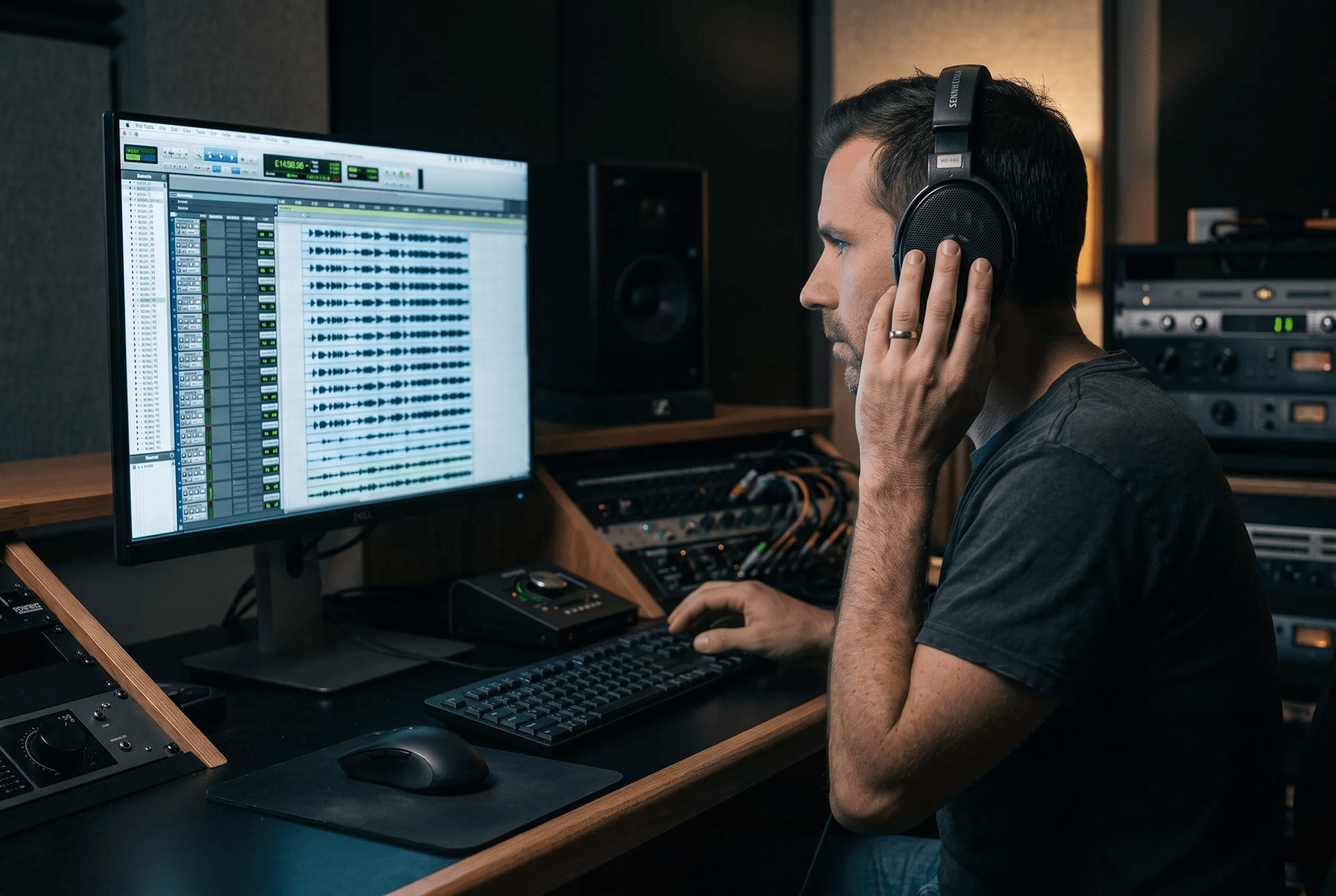
A feature turnover lands on Monday. One AAF, four hundred clips, dialogue and temp music and production effects all sitting on the same twelve tracks because that is how the picture editor cut it. By Wednesday three people need to be working on it at once: a dialogue editor, a music editor, an effects editor, each in their own session, each with their own template, all of them frame accurate against the same picture.
Getting from the first state to the second is a job with no name. It is not import, and it is not editing. It is the part where one delivery becomes three parallel workflows, and doing it badly is the reason a reconform two weeks later takes a day instead of an hour.
Why Facilities Split a Turnover at All
On a short piece nobody splits anything. One person preps the session, works it, mixes it, delivers. The split appears the moment the work is too big for one pair of hands, which on a feature or a series is immediately.
Dialogue, music and effects are different crafts on different clocks. Dialogue editing is a long, meticulous pass over production sound: cleaning, filling, ADR prep, matching perspectives. Music editing lives against picture and changes every time the cut changes. Effects work is additive and expands, often across hundreds of tracks that no dialogue editor needs to see or load. Put all three in one session and you get a file three people are fighting over, a track count that slows the machine down for everyone, and a save conflict every time two of them reach for it.
Split them and each editor gets a session sized to their own job, with their own template, their own routing, and their own plugin load. The work happens in parallel, and the sessions come back together at the mix stage as premixes rather than as one enormous edit session.
The other reason is the one the deliverables force. Dialogue, music and effects have to exist as separate stems at the end regardless of how the work was organised, because that is what an M&E delivery is: the full mix minus dialogue, so a distributor can dub the film into another language without rebuilding the soundtrack. A DME delivery goes further and hands over all three stems separately. If the three departments were never separated during the edit, they have to be untangled at the mix, which is a worse place to discover that a background and a line of dialogue are sharing a track. The post audio deliverables checklist covers what each distribution route actually asks for.
What Goes in Each of the Three, and Where the Line Gets Argued
The three way vocabulary is settled. What belongs in each bucket is less settled than it sounds, and the disagreement is real rather than sloppy.
| Department | Uncontested content | Where facilities disagree |
|---|---|---|
| Dialogue (DX) | Production sound, ADR, voice over and narration, efforts | Walla and crowd, and whether futz gets its own tracks or its own session |
| Music (MX) | Score, songs, source music | Whether on screen source music that a character can hear belongs to music or to effects |
| Effects (SFX) | Hard effects, designed effects, foley | Backgrounds and ambience, folded in by some rooms and kept as a fourth category by others |
Backgrounds are the genuine argument. Plenty of rooms fold ambience in with effects and route them together, while the Film Mixing and Sound Design blog keeps backgrounds as a top level category alongside dialogue, music, effects, foley and songs, and splits the sessions on a different line again, dialogue with foley in one, effects with backgrounds in another, music in a third, checked August 2026. Neither is wrong. What matters is that the decision is made once, written down, and applied identically on every project, because the person who suffers from an inconsistent answer is whoever does the reconform three weeks later.
Dialogue also subdivides further than the other two, and it is worth building that into the dialogue session from the start: production A and B rolls, ADR on its own tracks, futz for phone and radio treatments, and group or walla. Our dialogue edit prep workflow covers the shape of that session in detail.
What Has to Stay Identical Across All Three
The split only works if the three sessions remain interchangeable views of the same timeline. The moment one of them drifts, everything downstream is wrong, and the drift is rarely visible until the mix.
| What must match | Why | What goes wrong if it does not |
|---|---|---|
| Session start timecode | Every clip position is absolute, not relative to the session | Whole sessions land offset against picture, usually by exactly one hour |
| Frame rate | Picture and sound share one clock | Progressive drift that reads as sloppy sync rather than as a settings error |
| Sample rate and bit depth | Premixes have to sum without conversion | Pitch and timing shifts, or a conversion pass nobody budgeted |
| Video reference and its start point | All three editors are cutting to the same picture | Three editors confidently working to three different versions of a scene |
| Clip names and source metadata | The mix and the conform trace clips back to their source | A clip that cannot be traced is a clip that gets rebuilt by hand |
The two that get missed most often are the session start and the video reference, and they get missed for the same reason: they are set once, early, by whoever built the first session, and then inherited by copy without being checked. A session built to start at 00:00:00:00 and an AAF whose material sits at the standard 01:00:00:00 picture start will import happily and be wrong by an hour, and the error is invisible until someone plays it against picture.
Sample rate is the quiet one. Three sessions at 48 kHz sum cleanly. Two at 48 and one at 44.1 sum too, after a conversion nobody documented, and the pitch shift gets blamed on the mix.
Folder Tracks or Separate Session Files?
This is the question the older literature does not ask, because it did not exist when most of that literature was written. Pro Tools introduced folder tracks in version 2020.3, and a routing folder sums what is inside it exactly as an aux input does, with nesting up to eight layers deep, per Production Expert's reference on folder tracks, checked August 2026. That makes a single session with three routing folders a real alternative to three session files.
Folder tracks win when one person is doing all three jobs. Everything stays in one file, the departments collapse out of sight when you are not working on them, the stems already exist as the folder outputs, and there is nothing to keep in sync because there is only one session. For a commercial, a corporate piece or a short, this is the better answer and building three sessions is overhead.
Separate sessions win when separate people are working simultaneously. No amount of folder discipline lets two editors open the same file at once, and a feature effects session that reaches several hundred tracks with a full plugin load is not something a dialogue editor should have to open at all. The moment the constraint is human rather than organisational, folders stop being an option.
The practical answer for most rooms is both. Split into department sessions for parallel work, and use routing folders inside each one to keep it navigable. The two mechanisms solve different problems and the presence of one does not remove the need for the other.
The Split Is Rarely a Clean Three Way
The textbook version of this is dialogue, music and effects into three sessions. In practice facilities split along the lines of who they actually employ, and that varies more than the vocabulary suggests.
A feature with a full crew genuinely does split three ways, one editor per department. A television room often keeps music and effects together, because the same person handles both and a second session is pure overhead. A commercial house frequently wants dialogue isolated and everything else left alone, because the dialogue is the deliverable that gets approved and the rest is design that will change anyway. A documentary team might split by reel before splitting by content at all.
So the useful question at the start of a turnover is not how many sessions to make, it is who is going to open them. Build the split around the crew, not around the taxonomy. A three way split handed to two people creates a session nobody owns, and an unowned session is where clips go to be forgotten.
Doing It by Hand, in the Order That Does Not Break
The manual version is not difficult, it is just long, and the order matters more than the individual steps. Manual AAF prep runs two to three hours per session before any of this starts, and a badly ordered split adds to that rather than dividing it.
Prep once, then split. Import the AAF into a working session, sort the content, resolve the stereo problems, and verify sync before you divide anything. Splitting first means doing the same prep three times and then reconciling three versions of it.
Resolve stereo before the split, not after. Split mono pairs that arrive from a Premiere export have to be identified and re-interleaved while everything is still in one place. A pair separated across two output sessions is worse than a pair on non adjacent tracks, because now the two halves are in different files.
Save the untouched copy first. Before anything is divided, keep an unmodified version of the session as it arrived. This is the answer to what editorial actually sent, and it is the only reliable anchor when the next cut arrives.
Decide the department for every ambiguous track before you move anything. Editorial track names are not a classification. A1 mix, AUD 7, TEMP MX and PFX tell you what the picture editor was thinking, not what is on the clip, and a name that looks obvious is the one that catches people out: a track called PFX may hold production effects lifted from the dialogue recordings, which is effects content whose source is a dialogue microphone. The only reliable method by hand is to audition and decide, clip by clip rather than track by track, because a single editorial track routinely holds content from all three departments. Anything you cannot decide goes in a fourth holding area rather than into a department session on a guess, since a misfiled clip in a department session is worse than an unfiled one.
Split by category, into the right template each time. Each output session starts from the template that belongs to that department, not from a copy of the working session. A dialogue template is not an effects template with fewer tracks; it has its own routing, its own bus structure, its own ADR discipline. The mechanics of building those are covered in our guide to the Pro Tools session template as a facility standard.
Move the material with Import Session Data, not by copy and paste. This is the native mechanism and it is the one most accounts of this workflow skip entirely. From the destination department session, File > Import > Session Data points at the working session and pulls in the tracks you select, with their clips, at their original timeline positions. It also runs in the other direction, which is what makes the split reversible: when the dialogue editor finishes, the mix session imports their tracks back the same way. Copy and paste between sessions loses positions, playlists and fades in ways that only show up later.
Verify each output against picture independently. Three sessions means three chances for an offset. Check each one at the same reference point before anyone starts working, because an offset caught on day one is a settings fix and an offset caught on day five is a day of re-syncing.
Where the Metadata Decides Whether the Split Survives
A split turnover is fine until the cut changes, which it will. When the new AAF arrives, every one of those three sessions has to be updated to match the new picture, and the tool doing the conform can only move a clip it can trace back to its source.
That traceability is metadata: scene, take, channel name, original timecode. It comes off the production sound recorder, travels through the picture edit, and survives the AAF export to varying degrees depending on which NLE wrote the file. Our reference on what AAF metadata survives the export covers where it gets lost.
The practical consequence for a split is that incomplete metadata multiplies. A clip with no traceable source is a manual rebuild in one session. The same clip type scattered across three sessions is three manual rebuilds, in three different rooms, by three people who each assume someone else has already noticed. Knowing which clips are conformable before the split, rather than discovering it during the reconform, is the difference between a scheduled task and a bad afternoon. The conform workflow after picture lock is where that bill arrives.
This is also why episodic work is a different problem from a feature. Ten episodes arriving as ten AAFs, each needing its own split, is covered separately in our guide to the multi AAF episodic workflow.
How fPost Suite Handles the Split
Splitting a turnover is one of the places where the manual work is entirely mechanical, which makes it a reasonable thing to hand to a tool. fPost Suite includes a session splitter built for exactly this decision.
For each output session, you choose the starting point: an existing session, one of your templates, the session currently open in Pro Tools, or a new empty one, and you can bring your own template tracks into any of them. Then you compose the outputs by category with no fixed shape. Dialogue, music and effects each into their own session if that matches your crew, or music and effects together in one session and dialogue on its own if that matches it better. The reason it is built as a composition rather than a three way button is the point made above: facilities do not all split the same way, and a fixed three way split would only serve the ones that do.
The classification underneath it is fPost's on device AI-R engine, which reads the audio content of each clip rather than its track name and places it into your template. That is the part that addresses the ambiguous name problem above: a clip on a track called AUD 7 is classified by what it contains, and because the decision runs per clip, an editorial track holding content from all three departments does not have to be assigned to one of them wholesale. In Studio that runs at the macro level, dialogue, music and sound effects. Suite adds finer subcategories, with published examples including sync dialogue, instrumental music and foley, so material lands on its own template track rather than sharing one with everything else in its macro category. Clips land at their source timecode, existing routing is left untouched, and the original AAF is never modified, so the import can always run again from the untouched source. Suite also exposes the source metadata for each clip, scene, take, channel name and original timecode, which is the information the section above says you want in front of you before the split rather than during the reconform.
One thing fPost does not do is conform. It tells you whether a clip is conformable and hands off to the dedicated tools built for that job. It also does not decide how your facility should be divided; the split shape is yours to define, and the tool executes it.
Suite requires Pro Tools 2024.3 or later and macOS 13 or later. It is EUR 348 a year or EUR 59 a month, or EUR 1,399 one-time as Suite Lifetime. Pricing sits on the pricing page, and there is a demo if you want to see it run on a turnover shaped like the ones you receive.
Frequently Asked Questions
Can Pro Tools split a session by category on its own?
No. Pro Tools can import an AAF into one session and you can copy that session and delete what each department does not need, which is the manual method most rooms use. There is no native operation that takes one delivery and produces several category specific sessions, each built from its own template.
What is the difference between DME and M&E?
A DME delivery hands over three separate stems, dialogue, music and effects, so a distributor can rebuild or alter any one of them. An M&E delivery is a single stem containing music and effects with the dialogue removed, which is what a dubbing house needs to record a foreign language version over the top. DME is the fuller deliverable and M&E can be derived from it, which is one reason the three departments are kept separate through the edit rather than merged and then untangled.
Can folder tracks replace splitting the session?
For one person, usually yes. Routing folders sum their contents like an aux input, they nest up to eight layers, and the department stems exist as the folder outputs, so a single session stays navigable and delivers correctly. What folders cannot do is let two editors work at the same time, which is the only reason separate session files exist. Most rooms use both: separate sessions for parallel work, routing folders inside each one for legibility.
Should dialogue, music and effects always be separate sessions?
Only if separate people are working on them. The split exists to let parallel work happen; if one editor covers music and effects, two sessions for one person is administrative overhead with no benefit. Build the split around the crew.
What has to match between the split sessions?
Session start timecode, frame rate, sample rate and bit depth, and the video reference and its start point. Clip names and source metadata also need to survive, because the mix and any later conform depend on tracing a clip back to where it came from.
How do the split sessions come back together for the mix?
Each department delivers premixes rather than the whole edit session. The mix stage receives dialogue, music and effects stems that sum against the same timeline, which is why the sample rate and start timecode had to match from the beginning.
What happens to the split when the picture changes?
Each session has to be conformed to the new cut independently, and each one can only be conformed automatically for the clips whose source metadata is intact. Checking that before the split rather than during the reconform is the single most useful habit here.
Does splitting a session lose plugins or routing?
It does if the output sessions are built as copies with tracks deleted, because what survives is whatever the working session had rather than what each department's template specifies. Building each output from its own template keeps the plugins, sends and routing that belong to that department intact.
fPost prepares an AAF into an organised Pro Tools session, and Suite composes that material into as many sessions as the room needs. Details at forte-ai.com/fpost.