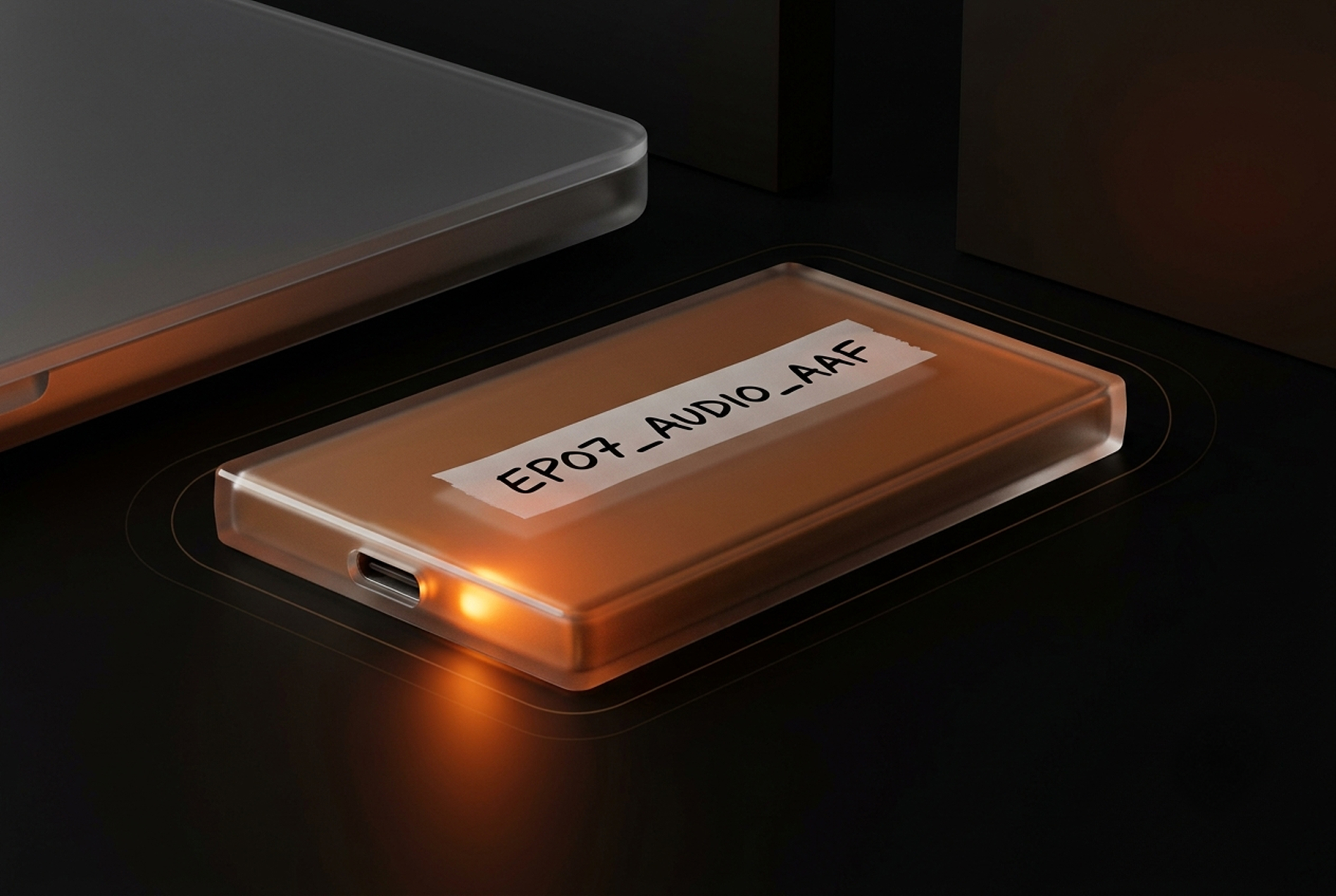
You already chose your DAW. Pro Tools or Nuendo is where the creative work happens, and that decision is rarely the one slowing you down. The hours that disappear before you touch a fader are the problem: importing the AAF, working out what is on each track, rebuilding routing to match your template, splitting fake stereo, prepping stems, bouncing deliverables, reconforming when picture changes. That work is invisible to the client, it is not billable, and on a normal session it costs two to three hours, sometimes most of a day on a series or a commercial batch.
So "what is the best audio post production software" is the wrong question for a working engineer. The DAW is the environment. The choice that matters is which automation tools you bolt onto it to remove the non-creative time. This guide covers that layer: the tools that automate session prep, stem export, conform, and repair, grouped by where each one sits in your pipeline so you can match the tool to the bottleneck instead of buying another editor you do not need.
Why "Best Audio Post Software" Is the Wrong Question
A DAW and an automation tool answer different questions. A DAW is where you record, edit, and mix. An automation tool removes a repetitive, non-creative step that the DAW makes you do by hand. Pro Tools will let you import an AAF, but it will not name the tracks, sort dialogue from effects, or rebuild your routing. It will bounce a mix, but it will lock the session while it prints and leave you naming and routing every stem yourself.
That gap is where the two to three hours go, and it is the same gap whatever DAW you run. The market has also shifted underneath it. There is rarely budget for an assistant anymore, work that used to need a team now falls on one person, and post is moving toward freelancers and home studios. The people carrying the full prep burden are exactly the ones with the most to gain from automating it. So the tools below are not ranked "best to worst." They are grouped by the stage they automate, because the right one depends entirely on where your time is actually leaking.
How to Evaluate an Audio Post Automation Tool
Five questions separate a tool that helps from one that adds a step:
- Which pipeline stage does it automate? Prep, stems, conform, and repair are different jobs. A bounce tool does nothing for a messy AAF import.
- Is it reliable enough to trust unattended? This is the bar that matters most. The verification cost of checking an automated tool's work can equal or exceed doing the step by hand. A tool that is right 80% of the time is not really automation, because you still audit every session to find the 20%. Reliability beats raw speed.
- Does it understand your template? A facility template is not a starting point, it is the operating system of the room: every track, bus, routing path, and color carries meaning. A tool that imports tracks but ignores your template hands the rebuild back to you.
- Platform and offline constraints. macOS or Windows, the DAW versions it supports, and whether it runs fully offline matter for facilities where media cannot leave the workstation.
- Total cost against time returned. A tool that reliably saves hours a week is cheap next to what the DAW itself costs. Judge price against recovered time, not against zero.
The Audio Post Automation Stack, by Pipeline Stage
Picture Handoff to Mix-Ready Session: fPost
The first bottleneck in any post job is the AAF handoff from picture editorial. An AAF that imports without errors is still not a session you can mix: tracks arrive named Audio 1, 2, 3, dialogue and effects are mixed across tracks, stereo is often split into mono pairs, and nothing matches your routing.
fPost automates that stage. Its AI-R technology classifies incoming audio by content, as dialogue, music, or SFX, rather than reading track names, then restructures the session to match your template: routing, folders, colors, and I/O. It detects split mono masquerading as stereo and reconstructs the pair, preserves an untouched safety copy of what editorial sent, and keeps timeline, automation, and timecode intact on import. The result is the two to three hours of manual AAF prep coming down to minutes.
fPost runs on macOS with Pro Tools and has a free trial of 7 days with a demo on request. It is the prep-stage entry in the stack, and it pairs with the conform tools below when picture changes mid-project.
Conform and Reconform After Picture Change: EdiLoad and Matchbox
When a new cut arrives mid-project, the job is conforming the existing audio session to the picture change without rebuilding it. EdiLoad (Sounds In Sync) compares picture edit lists (EDL, AAF, or XML) and reconforms Pro Tools sessions, and Matchbox (The Cargo Cult) compares the old and new cuts and reconforms the Pro Tools session to the new picture. Both are specialist conform tools that complement a prep tool rather than replace it: fPost gets the session mix-ready, these keep it aligned when editorial recuts. See how the handoff works: EdiLoad EDL compare and reconform, how Matchbox handles picture changes.
Scripting and Macros Across the Session: Soundflow
Soundflow automates Pro Tools through scripting and macros: you build or install routines that fire menu sequences and key commands. It is complementary to everything above, not a competitor, and engineers who use it describe it as a genuine efficiency gain. The distinction is that Soundflow automates the clicks you define; it does not understand what is on a track. For content-aware prep you still want a classification tool, and the two work well together.
Dialogue Repair and Restoration: iZotope RX
iZotope RX automates the repair stage rather than the prep stage: de-noise, de-click, dialogue isolation, and spectral repair, much of it now one-click or assistant-driven. It is not a session-prep tool and it is not a DAW; it is the cleanup layer that runs alongside one. On a dialogue-heavy job it sits downstream of prep and upstream of the final mix.
What the DAW Now Automates Natively: Pro Tools
Worth noting because it changes the math on some tools: since Pro Tools 2025.6, Studio and Ultimate include an AI speech-to-text engine that transcribes dialogue onto the timeline and makes it searchable and editable by text, so a slice of dialogue prep is moving into the DAW itself. Speech-to-text does not touch AAF organization, stems, or conform, so the stack above still applies, but it is a reason to check what your DAW version covers before buying a tool for a step it now handles.
Comparison: Where Each Tool Fits
| Tool | What it automates (DAW) | Where it fits |
|---|---|---|
| fPost | AAF import + PTX session prep: content classification (dialogue/music/SFX), template routing, stereo repair, safety copy (Pro Tools, macOS) | Picture handoff to mix-ready session |
| EdiLoad | Edit list compare (EDL, AAF, or XML) and session reconform (Pro Tools) | Conform after picture change |
| Matchbox | Old and new cut compare and session reconform (Pro Tools) | Conform after picture change |
| SoundFlow | Scripted menu and key-command macros (Pro Tools + others) | Repetitive clicks across any stage |
| iZotope RX | Dialogue repair, de-noise, spectral restoration (standalone + DAW) | Cleanup, downstream of prep |
| Pro Tools (native) | AI speech-to-text: transcripts on the timeline, searchable and editable by text (Studio and Ultimate, 2025.6+) | Inside the DAW, dialogue prep |
How the Pieces Fit Together
No single tool automates an entire audio post pipeline, and the ones that claim to usually do one stage well and the rest poorly. A working stack is assembled, not bought whole: a prep tool that gets the AAF to mix-ready, a conform tool for when picture recuts, repair for dialogue, and scripting to glue the repetitive clicks together.
Forte, for audio post, sits at the one stage that cost the most unbilled time, prep, with fPost, and works alongside the conform, scripting, and repair tools rather than trying to replace them. The point of the stack is not to own every step. It is to make sure no step is still being done by hand at 11pm when it could have run while you were mixing.
Frequently Asked Questions
What software do professional audio post engineers actually use?
A DAW as the core (Pro Tools is the facility standard, with Nuendo common), plus a layer of automation and specialist tools around it: a session-prep tool for AAF import, a conform tool for picture changes, and a repair tool such as iZotope RX for dialogue. The DAW is the constant; the automation layer is where engineers differ.
Can you automate AAF import into Pro Tools?
Yes. Pro Tools imports the AAF, but getting from a raw import to a mix-ready session, naming, sorting, routing, stereo repair, is the part you can automate. fPost does this by classifying audio content as dialogue, music, or SFX and rebuilding the session against your template, which takes the usual two to three hours of manual prep down to minutes.
Is iZotope RX a DAW?
No. iZotope RX is an audio repair and restoration tool that runs as a standalone editor or as plugins inside a DAW. It cleans dialogue and removes noise; it is not built for multitrack recording, mixing, or session prep. It sits alongside a DAW, not in place of one.
Do I need automation tools if I already have Soundflow?
They solve different problems. Soundflow automates sequences of clicks and key commands that you define. It does not understand what is on a track, so it cannot decide that a clip is dialogue or that a file is fake stereo. Content-aware prep and scripting are complementary: many engineers run both.
Related Guides
- AAF Guide for Audio Post Production: the pillar, what AAF is and why prep is the bottleneck
- How to Automate AAF Prep in Pro Tools with fPost
- Stem Export Automation in Pro Tools
- Batch Bounce in Pro Tools
- fMusic and Bounce Factory: How They Differ
- fMusic and Fast Bounce: How They Differ
- EdiLoad: EDL Compare and Reconform for Pro Tools
- How Matchbox Handles Picture Changes in Pro Tools
- DAW Automation Tools: What They Are and Why You Need One
- Forte AI is an Avid-Certified Integration
fPost automates the AAF-to-mix-ready stage on Pro Tools; fMusic automates stem prep and bounce across Pro Tools and Logic Pro. See forte-ai.com/fpost and forte-ai.com/fmusic.
.jpg)